


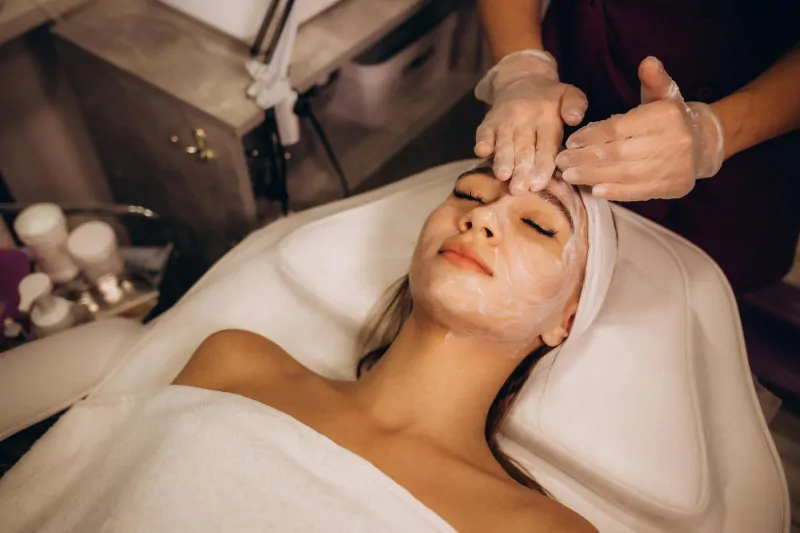
Choosing a Facial Spa, A Technical Decision Masquerading as Lifestyle. Looking at the menu of treatments at a spa and being wooed by soft lighting, eucalyptus and air conditioned space gives one little information about whether or not the esthetician can correctly read your skin and develop a great plan for your specific skin and goals. The following is a work in progress that outlines the qualities one can look for to determine if a spa is good enough for you, to send your clients to or to compare to another competing spa.
Credentials that actually predict outcomes
The minimum number of hours that an esthetician has to complete in school to obtain a license is set by each state. The majority of hours of the esthetician’s training go to learning how to keep clients and themselves clean, as well as how to have a general knowledge of skin anatomy and the basic ways to take care of skin. However, these hours do not have to include advanced training in depth chemical exfoliation, advanced device use, or treating post-inflammatory hyperpigmentation on skin of color.
Be sure to ask about any continuing education the individual esthetician has taken. Unless a facial spa is part of a large Dermatology Practice, most only have training in basic skin care and will send clients who need more intense treatments to someone else. If they have had advanced training in chemical peels, or are experienced with devices such as microdermabrasion, this is very important.
Questions worth asking before booking
- How long has the practitioner been performing the specific treatment under consideration, and roughly how often do they perform it?
- Which product and device lines do they hold current certification in?
- What is the protocol when a client reacts badly, and who is reachable after hours?
- Do they document skin condition photographically at baseline and at intervals?
Reading the treatment menu critically
A menu of many treatments may mean that most of them are variations on a few basic treatments. Typically, a spa with many treatments on the menu will have 3 basic treatments and can rebrand them by changing the name, the smell of products used, and the serums used.
A good esthetician’s clinic has structure. Even if they have lots of different “facials”, they typically can tell you what types of exfoliation they use in terms of concentration (so you can start slow and increase the intensity of treatments over time). Importantly, they typically separate services that are meant to be relaxing from services that are intended to correct skin problems and produce visible results, even if that result is for a short time (e.g. Several days). If you are comparing options locally, a Jacksonville FL facial spa that publishes this kind of structured protocol is generally the safer booking.
Matching modality to concern
| Primary concern | Typical appropriate modalities | What should raise a flag |
| Inflammatory acne | Salicylic or mandelic peels, LED blue light, careful extraction | Aggressive manual extraction without pre-softening, heavy occlusive masks |
| Hyperpigmentation | Tyrosinase-inhibiting topicals, gentle layered acids, strict sun protection counseling | High-energy heat-based treatments on Fitzpatrick IV to VI without patch testing |
| Rosacea and reactivity | Barrier-focused protocols, LED, enzyme exfoliation | Steam, mechanical scrubs, high-percentage glycolic |
| Laxity and texture | Microneedling, radiofrequency, retinoid-supported home care | Single-session promises, no plan for the twelve weeks that follow |
What a serious consultation looks like
Consultations vary greatly from practice to practice but typically last anywhere from 15-20 minutes or so prior to applying any products to the skin. The provider will inquire about your current medications including isotretinoin and other photosensitizing agents as well as your recent sun/tanning exposure. Also, if you have had any recent injectables, any allergies that you have, and lastly a review of your current home care products and their concentrations.
Expect the practitioner to get out the magnifying glass and tell you specifically what he or she sees in your skin. He or she should be able to tell you your Fitzpatrick skin type and why your skin type affects the plan for your treatment. Don’t be fooled by a long list of products that they offer for home care. The practitioner should be able to tell you specifically what each product does and recommend similar products. And most importantly, the practitioner should be able to tell you specifically what the treatment will not do for your skin. If the practitioner’s consultation ends with an upsell for additional treatments then you know you are in a sales situation and the practitioner is most likely not knowledgeable about skin.
Signals of a well-run plan
- A stated series length with intervals, rather than an open-ended commitment.
- Home care recommendations that include products the clinic does not sell.
- Explicit downtime expectations, given before payment rather than after.
- A defined point at which the plan will be reassessed and possibly abandoned.
Hygiene standards you can verify on sight
You can usually spot uncleanliness in facial treatment, usually unobserved, in low grade cases of folliculitis, slight breakouts which are incorrectly attributed to ‘purging’, or other strange reactions to treatment. Lancets are usually single-use, but sometimes these are opened in front of you and then used to extract spots or to make minor incisions. Extraction tools (e.g. Comedone extractors) are usually stored in sealed pouches between clients, and not in a solution in a jar on a shelf. Products are often decanted from a bulk bottle using a clean spatula, as opposed to being scooped out with the practitioner’s fingers. A sharps container should be provided in the treatment room where relevant.
Linens are changed between clients and the practitioner washes hands in front of the client. The practitioner states whether or not they perform any skin penetration treatments such as micro-needling and if they use an autoclave to sterilize all instruments and if they have a log to prove sterilization of all instruments.
Weighing it all up
Pricing is loosely correlated with quality and very much with geography. But in the end the only test is whether a spa can back up its claims. Someone who manages expectations, does only what he is good at, follows a client’s progress and is worth more in a year than the cheapest facial on the block, no matter what that is, is a very good spa.
