


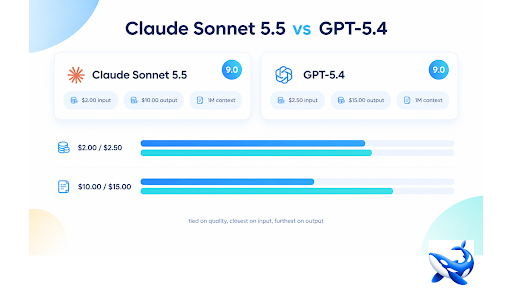
Some pairs are decided by one dramatic number. On OrcaRouter the Claude Sonnet 5.5 vs GPT-5.4 comparison is decided by which of two numbers you happen to care about, and the two point in opposite directions. On input the cards are 25 cents apart. On output they are five dollars apart. They carry identical windows and identical composite scores, so the entire decision turns on the shape of your token mix — which is exactly the kind of question a single headline price cannot answer.
Both cards, read off the page
Read on 2026-10-13:
| metric | Claude Sonnet 5.5 | GPT-5.4 | gap |
| input, per million tokens | $2.00 | $2.50 | Sonnet 5.5 is 20% cheaper |
| output, per million tokens | $10.00 | $15.00 | Sonnet 5.5 is 33% cheaper |
| output-to-input multiple | 5.0x | 6.0x | Sonnet 5.5 bills more gently |
| context window | 1M | 1M | identical |
| composite quality, 0–10 | 9.0 | 9.0 | tie |
The asymmetry between those first two rows is the whole story. A 20% input difference is the kind of gap that disappears inside a rounding error on a monthly invoice. A 33% output difference is not, and the billing multiples push it further: Sonnet 5.5 bills generated tokens at five times input, GPT-5.4 at six. So the card that is already cheaper on output gets cheaper still as your workload writes more, and the card that is more expensive on output gets more expensive on exactly the workloads where output dominates the bill.
The tie that removes the usual tiebreaker
Our composite quality column is ours: a 0–10 figure we compute from four families of evaluation we run against each endpoint — reasoning, code generation, long-context retrieval and instruction following — averaged into one number. It is not a third-party leaderboard, and no other team can reproduce it on their own harness.
Both cards sit at 9.0, and 9.0 is the crowded band of the twelve we price — three cards at 8.0, six at 9.0, three at 10.0, the entire field inside two points. A tie there establishes one narrow thing: on the four families we run, neither card buys a measured capability advantage. That matters here because it removes the argument that usually settles a close price call.
It also removes the second-most-common tiebreaker, because the context windows match at 1M. Neither card asks you to trade capacity for price. So this pair is as close to a pure bill comparison as the twelve-model set produces: same score, same window, and a price difference whose size depends entirely on how much text your workload generates rather than reads.
Two workload shapes, two different winners
The reason the headline ratio is useless on this page is that it does not exist. The gap is 20% on one line and 33% on the other, so any single “x times cheaper” figure is a statement about a token mix rather than about the models. Price the extremes instead.
A read-heavy pipeline — long documents in, short structured answers out — sits almost entirely on the input line, where the difference between $2.00 and $2.50 is a rounding error at any realistic volume. On that shape the pair is close enough that the choice should be made on integration comfort rather than cost, and the score column says the two are level anyway.
A write-heavy pipeline inverts it. Agent traces, long-form generation, reasoning chains that emit thousands of tokens before producing an answer, code synthesis with a lot of surrounding commentary — all of those put the output line at the centre of the bill, and there the gap is $5.00 per million tokens, compounded by a 6.0x against a 5.0x multiple. At that point Sonnet 5.5 is cheaper by a margin that shows up on a dashboard rather than in a footnote.
The matched case sits between the two: read a million tokens and write a million through each card, and Claude Sonnet 5.5 bills $12.00 against GPT-5.4’s $17.50. A $5.50 difference on a single balanced pair, and it moves further apart the more your workload writes.
Where GPT-5.4 has a case
It would be a mistake to read the table as a rout for one card. GPT-5.4 has the sixth-of-twelve position in the 9.0 band and a vendor lineup some teams are already standardised on, and there are two places where that is worth more than $5.50 per matched pair.
The first is existing integration. A team already running GPT-class endpoints has prompts, retry policy, structured-output parsing and evaluation baselines tuned to that family, and a 33% output saving does not always survive the cost of retuning those. The second is breadth of tooling: a larger ecosystem of SDKs, wrappers and reference implementations accumulates around the more widely adopted family, and for a small team the engineering hours saved can outweigh a per-token premium for a long time.
Neither of those is a column on this page, and that is the honest way to hold the comparison: the table measures price, capacity and quality and finds the two cards level on two of the three. What it cannot measure is the cost of the system you have already built around one of them, and on a pair this close that cost is often the deciding term.
The ratio only travels between 1.25 and 1.50
Saying there is no single ratio on this page is not the same as saying the ratio is unpredictable, and the bound is worth having. Price a million tokens at a five-percent write share and Claude Sonnet 5.5 comes to $2.40 against GPT-5.4’s $3.13 — a ratio of 1.30. At half output it is $6.00 against $8.75, or 1.46. At eighty percent output, $8.40 against $12.50, or 1.49.
The ratio is pinned between the two line ratios and can never leave them. Read-only traffic gives you the input ratio, 1.25. Fully write-weighted traffic gives you the output ratio, 1.50. Every real workload sits somewhere between, which means the honest way to state the gap is not “x times cheaper” but a bracket: Claude Sonnet 5.5 is between 20% and 33% cheaper per million tokens, and where you land inside that bracket is decided by how much text your workload writes rather than by the models.
The takeaway
Claude Sonnet 5.5 and GPT-5.4 both score 9.0 on our composite and both carry a 1M context window, so this pair resolves on price alone. Sonnet 5.5 is cheaper on both lines: $2.00 against $2.50 on input, $10.00 against $15.00 on output, with the gentler 5.0x output multiple widening that lead on write-heavy traffic. On a matched million-in, million-out pair the bills are $12.00 and $17.50.
Because the gap is 20% on one line and 33% on the other, there is no single ratio to quote — the size of the difference is a property of your token mix, not of the models. Read-heavy pipelines will find the two nearly interchangeable and should choose on integration comfort. Write-heavy pipelines will find the $5.00 output gap decisive. Both endpoints are live at list price behind a single key, so pricing your own mix against them is an afternoon’s work.
