


When selecting a rope access contractor, look for independently checked trade credentials, such as IRATA or SPRAT membership, certified and tested anchor systems, on-site Level 3 supervision, task-specific trade qualifications, and a clear emergency rescue plan that the team can carry out without outside help. Building owners and facilities managers should not judge height-access work by the number of certificates or the lowest price alone. They need to confirm that the contractor can control its equipment, staff, and structural safety under the exact conditions found at the building.
Hiring a partner who provides rope access services means looking past polished brochures and broad claims. Industrial rope access is an engineered way to place trained specialists in areas that standard access methods cannot reach. Choosing the right team means checking equipment records, insurance details, and the trade skills of the technician carrying out the work.
What Does a Rope Access Contractor Do?
Rope Access Services for Inspection, Maintenance, Repair, and Installation
Industrial rope access uses technicians who work on vertical surfaces, inside confined areas, and across unusual building shapes with specialist ropes, harnesses, and descent devices. These workers do much more than hang from rooftops. They carry out accurate non-destructive testing (NDT), structural surveys, leak checks, and mechanical inspections on structures that would otherwise be very hard to reach.
Rope access contractors also handle demanding maintenance work, including glazing replacement, concrete and mastic repairs, protective coating applications, and pest-control netting. Their work can cover heritage monument restoration, offshore oil platform rigging, high-rise window detailing, and repairs to composite wind turbine blades. They bring specialist repair work directly to the building façade or structure.
When Is Rope Access More Suitable Than Scaffolding or Lifts?
Scaffolding takes up a large amount of space and money. Putting up and removing pipe frames can take weeks, block public walkways, create security concerns, and place heavy loads on the ground. Mobile elevating work platforms (MEWPs) offer another option, but they may not work on soft landscaping, narrow city lanes, areas with height limits, or buildings with unusual overhangs.
Rope access works well where speed, limited ground disruption, and unusual building shapes matter. Technicians can set up their ropes, complete detailed structural work, and remove the system at the end of each shift, leaving the ground area clear. For small repair jobs or inspections spread across a large elevation, rope access can greatly reduce setup time and the period during which the public is exposed to work-at-height risks.
What Qualifications Should a Rope Access Contractor Have?
IRATA or SPRAT Certification and Technician Levels
Two main professional bodies set widely used standards for rope access: the Industrial Rope Access Trade Association (IRATA) and the Society of Professional Rope Access Technicians (SPRAT). Both groups use three qualification levels: Level 1, Level 2, and Level 3. A Level 1 technician learns basic movement and equipment checks. A Level 2 technician can handle more advanced rigging and hauling. An IRATA or SPRAT Level 3 technician is an experienced safety supervisor who can plan site-specific rigging, manage difficult rescues, and prepare detailed risk plans.
A reliable contractor does more than hire certified workers. It should also work under recognized company accreditation. Member companies follow strict operating audits, report safety information on a regular basis, and require every active work site to have a named Level 3 supervisor physically present on the ropes.
Training, Competency Assessments, and Ongoing Refresher Requirements
Rope access certificates do not last forever. IRATA and SPRAT both require workers to be reassessed every three years. During this process, technicians must show practical skills, technical knowledge, and rescue ability before an independent examiner. If a technician has been away from rope work for more than six months, they must complete refresher training before returning to height.
Clients should ask to see technician logbooks. These records show total working hours, the types of structures worked on, different rigging methods, and supervisor approvals. A current logbook shows that the worker still has recent practical experience and follows the correct procedures, rather than relying only on a course taken several years ago.
Licenses, Trade Qualifications, and Local Compliance
Rope access is a method of reaching a work area, not a trade qualification by itself. A technician using twin ropes to perform ultrasonic testing, weld a steel connection, or seal an expansion joint must also hold the right trade credentials. If your project includes electrical repairs or structural glazing, the contractor must have the licenses required by the local construction authorities.
Local laws also set requirements for employers, protective measures, and health checks. Examples include the Work at Height Regulations in the United Kingdom and OSHA or ANSI standards in the United States. A strong contractor should be able to show how its working procedures meet the rules that apply in your area.
Experience With Your Building Type and Scope of Work
Each type of building creates different access and safety problems. A glass curtain wall may require suction cups, careful movement around edges, and footwear that will not leave marks. Historic masonry needs gentle rigging that will not damage weak parapets or decorative cornices. Industrial sites may contain dangerous energy sources, steam, and chemical substances.
Check whether the contractor has worked on structures like yours. A company with many hours of experience on offshore wind farms may not have the local planning skills, tenant communication processes, or street-level protection methods needed for a busy commercial high-rise in a city. For urban projects, a local specialist such as Rope Access in London will usually know these requirements well.
How Should a Contractor Demonstrate Rope Access Safety?
A Site-Specific Risk Assessment and Method Statement
A legitimate contractor should never submit a generic health and safety document copied from another job. A proper Risk Assessment and Method Statement (RAMS) must relate directly to the building. It should cover parapet shapes, rope drop positions, pedestrian movement, and weather or other environmental risks.
The RAMS should set out the work in order and show the exact rigging arrangements, drop zones, barriers, PPE requirements, and chemical-handling steps. It should name the workers involved and include clear drawings of rope routes and edge protection. Without these details, the document is not a useful safety control.
Two-Rope Systems and Independent Safety Lines
Modern industrial rope access depends on backup protection. Technicians must connect to two separately secured systems. The main working line carries the worker’s weight. The second line is a safety line with an automatic fall-arrest device that locks if the working line fails.
The two lines must not finish at the same anchor point. They should connect to separate, strong anchors or to a properly engineered system with several connection points. The system should remain secure even if one part fails. This two-rope requirement forms a basic part of both IRATA and SPRAT practice rules.
Equipment Inspection, Maintenance, and Load Ratings
Every carabiner, descender, harness, rope, and ascender plays a life-safety role. Contractors should keep detailed records for each item, including its serial number, purchase date, inspection history, and retirement date. Equipment exposed to chemicals, strong sunlight, or a sudden heavy load must be removed from use and checked.
Competent contractors require technicians to carry out a hands-on check before every use. A named equipment inspector should also complete a detailed examination every six months. You should be able to choose any harness from the work kit and see its complete inspection and service history.
Rescue Plans for Suspension Trauma and Emergencies
A fall or medical emergency high above the ground leaves very little time for action. Suspension trauma, also called orthostatic intolerance, can make a trapped worker lose consciousness or suffer serious heart problems within ten to twenty minutes. Depending only on public emergency services is unsafe because traffic can delay them, and their teams may not have the rooftop equipment needed for a high-angle rescue.
A professional contractor prepares a separate, timed rescue plan for every rope drop. The team should keep rescue equipment at the site, practise raising and lowering rescues during toolbox talks, and show that its members can reach, secure, and lower an injured colleague within minutes.
Weather Monitoring, Communication, and Exclusion Zones
Wind can speed up around tall buildings and make a safe rope system swing out of control. A technician may be pushed against window frames or other building features, and heavy materials may become difficult to control. Contractors should set clear limits for wind gusts, lightning, and rain, and monitor conditions throughout the work with suitable instruments such as on-site anemometers.
Ground safety depends on a well-managed exclusion zone. Contractors should use barriers, warning signs, and trained ground spotters. These spotters need reliable two-way radio contact to protect people and vehicles from falling objects, dropped tools, and loose debris.
How Do You Assess a Rope Access Contractor’s Experience?
Relevant Projects, References, and Client Reviews
Do not rely only on the case studies shown on a company website. Ask for verifiable references from building managers and structural engineers who have directly supervised the contractor’s work. Ask clear questions: Did the team arrive with clean and well-maintained equipment? Did the daily safety meetings allow useful discussion? Did the contractor finish on time without causing problems for tenants?
Written reviews and independent supplier checks can show how a company acts when a job does not go as planned. They may reveal how it responds to unexpected structural defects, bad weather, or delays.
Qualified Supervisors and Adequate Crew Numbers
Using a single worker or sending a team made up only of junior Level 1 technicians under remote supervision is a serious shortcut. Professional practice calls for at least two rope access technicians, with one experienced Level 3 supervisor who can carry out an immediate technical rescue.
Two workers may not be enough for a large façade, several drop points, or work involving heavy tools. A capable contractor should set crew numbers based on the job. The team may need ground support, extra riggers, and additional rescue staff so that safety is not reduced to save on labor costs.
Specialist Experience With Facades, Structures, Confined Spaces, or Wind Turbines
Different industries require different skills. Working inside a silo or penstock may require gas testing, ventilation equipment, and special confined-space recovery systems. Repairing a wind turbine blade high above the ground may require knowledge of vacuum-bagged composite curing and aerodynamic shaping in strong offshore winds.
Confirm that the contractor has direct, verifiable experience in the setting where your work will take place. Ask for redacted technical reports from similar projects. These reports can help you judge whether the contractor records observations and engineering issues at the level your property requires.
Clear Communication Before, During, and After the Work
A company’s safety approach can be seen in the way it communicates. From the first site visit to the final handover, information should be clear, recorded, and shared early. Professional contractors provide contact lists, hold daily briefings with facilities staff, and report building defects or unsafe surface conditions as soon as they find them.
At the end of the job, the contractor should provide a clear handover. This may include digital photo records, marked-up structural drawings, and a list of completed tasks. Building managers should not have to guess what work was carried out high above the ground.
What Insurance and Documentation Should You Request?
Public Liability and Employer’s Liability Insurance
Standard commercial general liability policies often contain strict height exclusions. These exclusions may remove cover for work above a low level, such as two or three floors. A rope access contractor needs specialist public liability insurance that covers work at height and provides suitable limits for each claim.
Employer’s liability insurance must also clearly cover high-angle industrial rigging. If a worker is injured on your property and the contractor’s policy excludes rope-based work, the financial and legal responsibility may fall on the property owner or facilities management team.
Professional Indemnity and Contract-Specific Coverage
A contractor that prepares structural assessments, façade inspection certificates, or anchor design documents should carry Professional Indemnity (PI) insurance. Public liability insurance covers physical injury and property damage. PI insurance covers financial losses linked to incorrect advice, poor engineering approval, or a missed structural defect.
For valuable properties or essential infrastructure, ask for contract-specific policy endorsements. These should name your management company as an additional insured party and keep the protection active throughout the work.
Certificates of Insurance With Appropriate Coverage Limits
Do not accept a quotation letter that simply says insurance is “in place.” Ask for current Certificates of Insurance issued by the insurer or broker. The certificates should show the types of cover, policy numbers, start and end dates, clear cover for industrial rope access at height, and limits suitable for the size and value of the property.
Check that the legal name on the insurance certificate is exactly the same as the company signing and carrying out the contract. Shell companies and unknown subcontractors can make insurance cover difficult or impossible to enforce.
Written Inspection Reports, Permits, and Safety Records
Before any technician connects to a rope, request the full site safety file and check the following:
- Signed permits for the specific location, such as hot-work, roof-access, or confined-space permits.
- Anchor certification records and evidence of recent pull testing.
- Equipment inspection sheets and LOLER or OSHA thorough-examination certificates.
- Technician competency certificates and photo identification cards.
- Emergency medical contact details and maps showing routes to local hospitals.
A contractor that cannot quickly provide these basic compliance records creates an immediate safety concern.
What Should a Rope Access Quote Include?
A Detailed Scope of Work and Deliverables
A professional proposal should make the job boundaries clear. It should list the elevations, gridlines, and building features included in the work, along with the exact reports or other results you will receive at the end.
Whether the work involves pressure washing, ultrasonic crack testing, or small concrete spall repairs, the quote should name the materials, allowed tolerances, and industry standards that apply. This reduces disagreements about what counts as a finished task.
Labor, Equipment, Access, and Permit Costs
A clear quotation separates technician labor from other costs. It should list specialist equipment, disposable rigging items, edge-protection systems, and temporary barriers at ground level.
If the local authority requires road closures, pavement canopies, or permission to pass over a neighboring property, the quote should state who will arrange and pay for these items. It should also show any related administration costs.
Estimated Schedule and Weather Contingencies
Rope access work depends on weather conditions. Strong winds, heavy rain, and very high or low temperatures may stop outdoor descents. A professional quotation should give an estimated number of shifts and explain how weather delays will be handled.
Read the section about standby time and bad-weather delays carefully. Reliable contractors state their limits, standby rates, and rearrangement process clearly instead of hiding large delay charges in the small print.
Inspection Findings, Photographs, and Completion Reports
One major benefit of rope access is the ability to gather clear, close-up information about parts of a building that cannot be viewed properly from the ground. The proposal should state the format and quality of the final report package.
Expected deliverables may include high-resolution, location-marked photographs, annotated CAD or elevation drawings showing repair areas, video records where useful, and formal engineering recommendations approved by the lead supervisor or staff engineer.
Payment Terms, Guarantees, and Change-Order Conditions
Clear financial terms support a good working relationship. The quote should state invoice stages, deposit requirements, retention arrangements, and guarantees for workmanship and installed materials.
Pay close attention to the change-order process. If the team finds unexpected concrete damage, failed gaskets, or structural rust during a drop, the contract should provide a clear hourly or unit-rate method for approving extra work. This allows the work to continue without long delays.
What Warning Signs Should You Avoid?
Unverified Certifications or Expired Training
Do not accept printed or PDF certificates without checking them. False credentials and changed expiry dates can appear in the industrial sector. Recognized organizations offer online verification systems where you can enter a technician’s registration number and check whether the certificate is valid.
An operative with an expired certificate, or someone who cannot show a logbook with recent active hours, should not be allowed onto your rope system. Skipping this check creates serious safety risks and may mean the site does not meet its legal requirements.
Missing Insurance or Vague Safety Procedures
Use caution if a contractor gives you general insurance documents that do not mention work at height, or if the policy limits are far too low for the value of your property. General contractor policies often exclude high-risk industrial rigging without making the exclusion obvious.
Also be cautious if the contractor submits a standard safety handbook instead of a real method statement for your site. The documents should address your parapets, rescue routes, and ground exclusion areas. If they do not, the contractor may be treating safety as a paperwork exercise instead of a practical control.
Unusually Low Quotes With Unclear Inclusions
A price far below the other commercial bids is a serious warning sign. In rope access work, very low prices often come from unsafe shortcuts, such as reducing crew numbers, using unqualified junior workers without a Level 3 supervisor, shortening safety briefings, or delaying required equipment checks.
A quote that looks too good may lead to expensive changes later, poor trade work, or serious liability problems. These costs can be much greater than the money saved at the start.
Pressure to Start Without a Site Assessment
A contractor that agrees to set up ropes based only on a desktop review or online map images is taking an unsafe shortcut. Safe rope access requires a hands-on site survey. The survey should check anchor materials, look for structural corrosion, confirm edge-radius limits, and record hazards at ground level.
A company that wants to sign the contract and install ropes without visiting the roof is taking a serious risk with its workers and with the building owner’s legal responsibility.
How Should You Compare Rope Access Contractors?
Verify Credentials Directly With Certification Bodies
When making a shortlist, do not depend on company letterheads or website badges. Use the online directories provided by IRATA International or SPRAT to check the company and the technicians assigned to your building.
Confirm that the company is a current member in good standing. Also check that its named Level 3 supervisor has a valid, current certificate. This simple step can remove dishonest or unsuitable companies early in the buying process.
Compare Safety Standards Before Comparing Prices
Create a technical scoring system that looks at safety before reviewing the commercial bids. Check the contractor’s working systems, equipment records, internal audit results, and early safety measures. These may include how often the team practises rescues and how it reports near misses.
A contractor that openly records near misses and takes clear corrective action may have a healthier safety culture than a company claiming an impossible record of zero incidents and zero errors after years of difficult work.
Check Availability, Response Times, and Project Capacity
Find out whether the contractor has enough staff and management capacity to complete your work without overloading its skilled workers. Ask what happens if the named Level 3 supervisor becomes ill. Can the company send another person with the same qualifications without delaying the project?
Also check its response speed. If a storm damages the façade, a section becomes loose, or an urgent leak appears, can the company send a response team within hours to make the area safe?
Choose the Contractor With the Strongest Evidence of Competence
The final choice should be based on proof that can be checked. Give preference to contractors that provide clear details about their supervisors, equipment records, anchor assessments, rescue plans, and reporting examples.
The best rope access partner is not necessarily the company with the most impressive advertising or the lowest daily rate. It is the contractor that can show its access methods, trade skills, and emergency procedures will work under the exact conditions at your property.
Beyond the Contract: Establishing a Client-Side Assurance Framework
Hiring a high-quality rope access contractor does not remove the legal duties of property owners and facilities managers. Current health and safety law increasingly treats the client as a main dutyholder. As the organization commissioning work at height, you still have a duty to provide a sound structural setting that is certified and free from hidden dangers.
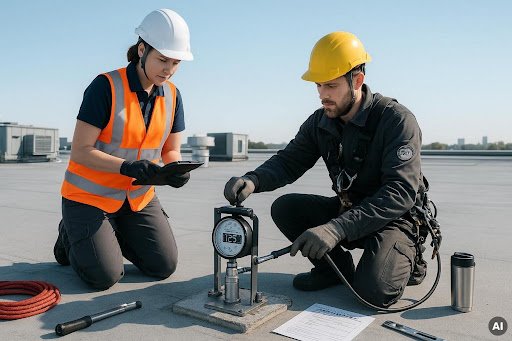
Anchor integrity is the main shared area of risk between building owners and external rope teams. Permanent structural anchors must be engineered, installed, and certified under recognized standards, such as EN 795, BS 7883, or similar local rules. These standards may require load capacities of up to 22.2 kN for each connected person. Anchors can weaken over time because of building movement, water entry, and electrochemical corrosion. Arrange an independent yearly inspection and pull test with a qualified structural engineer. Keep a dedicated roof-access logbook, and require contractor supervisors to check and sign it before attaching life-safety lines.
Also include clear stop-work powers in the contract. Everyone on site, from junior security staff controlling ground barriers to the client-side facilities manager, should have the unconditional right to stop the work at once if they see an open drop zone, a missing backup line, unsafe weather, or an unapproved change of crew. Combining a carefully checked contractor with active oversight from the client creates a shared safety system that protects people, valuable property, and the quality of work at height.
Please visit us: Freely Magazine
