


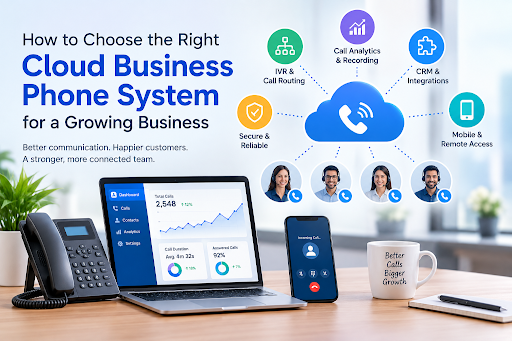
Business communication has changed significantly over the past few years. Teams no longer need to rely on traditional desk phones, complicated PBX hardware, or fixed office setups to manage customer calls. A cloud-based business phone system can give businesses a more flexible way to handle inbound and outbound communication while supporting remote teams, multiple departments, and growing call volumes.
However, choosing the right platform is not simply about finding a system that can make and receive calls. Businesses also need to consider call routing, IVR, analytics, integrations, scalability, security, and the overall experience for both employees and customers.
What Is a Cloud Business Phone System?
A cloud business phone system is a hosted communication platform that allows businesses to manage calls over the internet rather than depending on traditional on-premises telephone infrastructure.
Instead of installing and maintaining a physical PBX, businesses can manage users, numbers, extensions, call flows, and communication settings through a centralized online platform. This approach can make it easier to support employees across different locations while reducing the need for dedicated phone hardware.
For example, a growing company may have separate teams for sales, customer support, billing, and operations. A cloud phone system can organize incoming calls and route customers to the appropriate department without requiring a receptionist to manually transfer every call.
Why Businesses Are Moving Away From Traditional Phone Systems
Traditional phone infrastructure can become difficult to manage as a business grows. Adding new employees may require additional hardware, extensions, or configuration, while supporting remote employees can introduce additional complexity.
Cloud-based systems provide a different approach. Users can often access business communication tools through desktop, mobile, or web applications, allowing teams to stay connected even when they are not working from the same physical location.
Another advantage is scalability. Instead of rebuilding the phone infrastructure whenever the company expands, administrators can add users, numbers, departments, and call flows through the platform.
Key Features to Look For
Not every cloud phone system offers the same capabilities. Before choosing a provider, businesses should evaluate the features that will have the greatest impact on daily communication.
1. Multi-Level IVR
Interactive Voice Response (IVR) helps businesses organize incoming calls through automated menus. A caller might select sales, support, billing, or another department before being connected to an appropriate agent.
Multi-level IVR becomes particularly useful for businesses with several departments or complex call flows. It can reduce unnecessary transfers and help customers reach the right team more efficiently.
2. Intelligent Call Routing
Call routing determines where an incoming call should go based on rules such as department, agent availability, business hours, location, or other conditions.
Modern systems can support different routing strategies, including skill-based and time-based routing. This gives businesses more control over how calls are distributed and can help reduce missed calls during busy periods.
3. Call Analytics and Recording
Simply knowing how many calls a business receives is not enough. Managers often need to understand answer rates, missed calls, call duration, agent performance, and other operational metrics.
Call analytics can provide this visibility through centralized dashboards, while call recording can help teams review conversations for quality assurance, training, and compliance purposes.
4. CRM and Business Integrations
A phone system becomes more useful when it works alongside the tools a business already uses.
CRM integrations can connect customer information with conversations, helping sales and support teams maintain context during interactions. Businesses should therefore check whether a provider integrates with their existing CRM, helpdesk, productivity tools, and other essential applications.
5. Remote and Mobile Access
Modern teams are often distributed across offices, homes, and different regions. A cloud-based system should allow employees to access business calling features without being tied to a physical desk.
Mobile and web access can help employees make and receive business calls while maintaining a consistent company communication setup.
Security and Reliability Matter Too
Communication platforms handle sensitive business and customer information, so security should be part of the evaluation process.
Businesses should look for providers that offer appropriate security controls, encryption, authentication options, access management, and reliable infrastructure. They should also examine uptime commitments and data-handling practices before moving their business communication to a new platform.
How to Choose the Right Provider
The best approach is to start with the company’s actual communication requirements rather than choosing a provider based solely on the number of features listed on its website.
Start by identifying the number of users, expected call volume, departments, locations, CRM requirements, and remote-working needs. Then consider which features are essential, such as IVR, intelligent routing, call recording, analytics, virtual numbers, and integrations.
It is also worth considering how easily the platform can scale. A solution that works for a five-person team may not be suitable once the company has dozens or hundreds of employees.
For businesses comparing providers, TeleCMI is one example of a cloud communication platform that brings together business phone functionality with features such as multi-level IVR, call routing, call analytics, call forwarding, call monitoring, virtual numbers, and remote access. This type of centralized setup can be useful for organizations looking to manage business communication across different teams and locations.
Cloud Phone Systems and the Future of Business Communication
The shift toward cloud communication is not simply about replacing traditional phones. Modern platforms are increasingly combining voice communication with automation, analytics, CRM integrations, AI-powered capabilities, and omnichannel customer engagement.
As customer expectations continue to increase, businesses need communication systems that can adapt to changing workflows rather than forcing teams to work around outdated infrastructure.
When evaluating a provider, businesses should therefore look beyond basic calling capabilities. A modern cloud phone system should provide the flexibility to route calls intelligently, support distributed teams, connect with existing business tools, and provide meaningful insights into communication performance.
Final Thoughts
Choosing a cloud phone system is an operational decision that can affect sales, customer support, employee productivity, and the overall customer experience.
Businesses should compare providers based on their specific requirements, including call management, IVR, routing, analytics, integrations, security, mobility, and scalability. By focusing on these practical requirements rather than choosing based on feature count alone, organizations can select a communication platform that supports both their current operations and future growth.
