


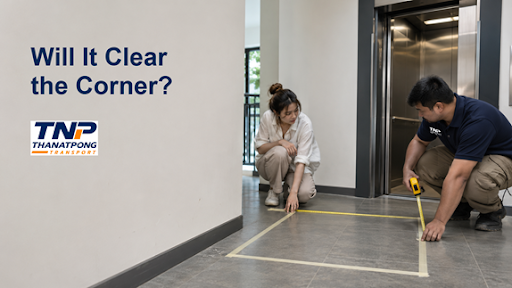
Picture a hypothetical condo resident in Bangkok who knows exactly where her sofa will go. She has even marked its footprint on the living room floor. The trouble is outside the apartment: the elevator opens onto a landing with a wall close opposite. The room can take the sofa. Whether the landing can take the turn is a separate question, and it’s the one to settle before reserving the elevator.
Measure the Sofa and the Tightest Opening
Measure the sofa in the condition in which it will travel. That means its overall length, depth, and height at the widest points, with any fixed arms or feet included. If it arrives boxed or wrapped, obtain the outside measurements for that configuration too. The useful dimensions describe the thing the movers will actually carry, not just the space it will occupy once set down.
On the building side, record the clear width and height of the elevator doorway, then get the usable width, depth, and height of the cab from management or measure with its permission. A railing can take away space inside the cab even when the door looks generous. Follow the route to the apartment and measure the clear gaps at any narrower door or passage. Label the measurements in centimeters on a quick sketch so the doorway and the inside of the cab cannot be confused.
Check the Turn, Not Just the Door
The sofa needs somewhere to go as it leaves the elevator. On the hypothetical landing, the key measurement is the distance from the opening to the opposite wall, read alongside the width of the corridor it turns into. Note a low ceiling or a fixed cabinet that takes space out of that turn. A wide enough opening and a roomy cab do not help if the far end of the sofa runs out of space on the landing.
Take pictures looking both ways at that corner and pair them with the sketch and sofa measurements. If you’re asking TNP Thanatpong Transport about the move, use those details to ask whether the proposed route can be assessed. Check the maker’s instructions before treating anything as removable. If the manufacturer permits the feet to come off, record the revised dimensions and ask who, if anyone, would be responsible for removing and refitting them. Removing the feet may help with height without solving the turn. If the arms are the widest part, the new measurements may leave the problem exactly where it was.
Book the Lift After You Know the Fit
A reservation confirms a time, not a fit. Before choosing the slot, check which elevator management permits for furniture, whether it will have protective padding in place, and what restrictions apply. Make sure the measurements describe that elevator as it will actually be used. Let the moving team judge close clearances; do not force the sofa through or rely on a different route that has not been checked and approved.
If the sofa works whole, reserve the approved elevator for that plan. If it works only with manufacturer-approved parts removed, make that the agreed configuration before booking. The practical next step is small: walk to the landing, add the return turn to your sketch, and send it with the dimensions. If the plan still depends on an unmeasured corner, the reservation can wait.
