


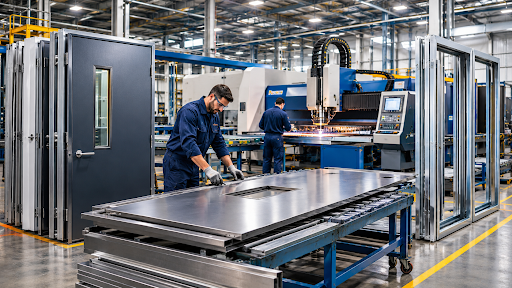
Commercial doors are essential components of modern buildings, providing security, accessibility, durability, and protection. They are widely used in offices, hospitals, schools, shopping centres, warehouses, and industrial facilities. Unlike residential doors, commercial systems are designed to withstand frequent operation, demanding environments, and strict safety requirements.
Commercial Door Manufacturing combines engineering, material selection, precision fabrication, and quality control to produce reliable door systems. Modern manufacturers use advanced machinery and specialised production techniques to create products that meet different architectural and operational requirements.
Quick Facts About Commercial Door Manufacturing
| Category | Details |
| Industry | Construction and manufacturing |
| Main Products | Steel, aluminium, glass, and fire-rated doors |
| Common Materials | Steel, aluminium, wood, glass, and composites |
| Applications | Offices, hospitals, schools, warehouses, and factories |
| Manufacturing Methods | Cutting, welding, forming, assembly, and finishing |
| Key Features | Security, durability, insulation, and fire resistance |
| Main Customers | Contractors, architects, developers, and businesses |
What Is Commercial Door Manufacturing?
Commercial Door Manufacturing is the industrial process of designing, producing, assembling, and finishing doors intended for commercial and institutional properties. These products are engineered to handle heavier usage and provide greater structural reliability than many standard residential doors.
The process involves several stages, including material selection, cutting, shaping, fabrication, hardware installation, and performance testing. Manufacturers also consider building regulations, accessibility requirements, fire protection, and security specifications.
Different buildings require different door solutions. Hospitals may prioritise accessibility and hygiene, while warehouses need strong doors capable of handling frequent industrial activity. Consequently, manufacturers develop specialised products for individual applications.
Types of Commercial Doors
Steel Doors
Steel doors are popular in commercial buildings because of their strength, durability, and resistance to physical damage. They are commonly installed in offices, factories, schools, and storage facilities.
Manufacturers often use hollow metal construction to reduce weight while maintaining structural strength. Depending on their design, steel doors can also incorporate insulation and fire-resistant cores.
Aluminium Doors
Aluminium doors are frequently used in modern commercial architecture. Their lightweight construction, corrosion resistance, and contemporary appearance make them suitable for offices, retail stores, and building entrances.
They can also accommodate large glass panels, allowing natural light to enter interior spaces.
Glass Commercial Doors
Glass doors provide an attractive appearance and improve visibility between different areas. They are commonly found in shopping centres, corporate offices, hotels, and commercial reception areas.
Tempered and laminated safety glass are frequently used to improve resistance to breakage and reduce injury risks.
Fire-Rated Doors
Fire-rated doors are specially designed to help restrict the spread of fire and smoke. They are important in hospitals, schools, commercial buildings, and industrial facilities.
Their construction may include specialised cores, fire-resistant materials, seals, and compatible hardware. Their performance depends on tested and approved door assemblies.
How Commercial Doors Are Manufactured
Commercial Door Manufacturing involves several interconnected production stages.
1. Design and Planning
Manufacturers begin by identifying the required dimensions, materials, performance characteristics, and installation environment. Technical drawings and specifications guide the production process.
2. Material Selection
Steel, aluminium, glass, wood, and composite materials are selected according to the intended application. Material quality directly influences durability, appearance, insulation, and overall performance.
3. Cutting and Fabrication
Industrial cutting equipment shapes raw materials into the required dimensions. Depending on the product, manufacturers use CNC machinery, laser cutting, bending, and welding to create accurate components.
4. Assembly and Hardware Installation
Door panels, frames, hinges, locks, handles, and other accessories are assembled. Accurate alignment is essential because poorly fitted components can affect operation, security, and durability.
5. Finishing and Quality Control
Manufacturers apply protective coatings, paint, or other finishes to improve appearance and resistance to corrosion. Finished products are inspected for dimensional accuracy, structural quality, and operational performance.
Materials Used in Commercial Door Manufacturing
Material selection is one of the most important decisions in production.
- Steel: Provides strength, security, and resistance to heavy use.
- Aluminium: Offers lightweight construction and corrosion resistance.
- Glass: Supports modern architectural designs and natural lighting.
- Wood: Provides traditional aesthetics and specialised interior applications.
- Composite materials: Combine different material properties to achieve particular performance requirements.
Manufacturers evaluate cost, maintenance, environmental conditions, and expected service life before selecting suitable materials.
Modern Technology in Commercial Door Manufacturing
Technology has improved manufacturing accuracy, production speed, and product consistency. Computer-controlled cutting systems allow manufacturers to produce components with precise measurements, while automated machinery reduces repetitive manual operations.
Advanced production facilities also use digital design software to develop customised door configurations. These systems help manufacturers coordinate dimensions, hardware positions, and installation requirements before production begins.
Another important development is the growing use of automated door systems. Sensors, electronic access controls, and automatic operators are increasingly incorporated into commercial entrances to improve convenience and accessibility.
Importance of Quality and Safety Standards
Quality assurance is essential because commercial doors often serve as important safety and security barriers. Manufacturers must consider relevant building codes, fire-rating requirements, accessibility provisions, and product testing standards.
Fire-rated assemblies, for example, must be tested and certified for their intended applications. Similarly, accessible entrances should provide appropriate clearances and operating features.
Regular inspections help identify manufacturing defects, alignment problems, and finishing inconsistencies before products reach customers.
Factors to Consider When Choosing a Commercial Door Manufacturer
Selecting an appropriate manufacturer requires more than comparing prices. Businesses should evaluate several important factors:
- Product quality: Examine construction materials, finishes, and manufacturing consistency.
- Industry experience: Consider experience producing doors for similar commercial environments.
- Customisation: Check whether the manufacturer offers suitable dimensions, finishes, and hardware options.
- Compliance: Confirm that products meet applicable building and safety requirements.
- Customer support: Reliable technical assistance and after-sales service can simplify installation and maintenance.
A suitable manufacturer should provide clear specifications and recommend products based on the building’s actual requirements.
The Future of Commercial Door Manufacturing
The industry continues to evolve through automation, improved materials, and smarter building technologies. Manufacturers are increasingly exploring energy-efficient designs, recyclable materials, electronic access systems, and advanced production equipment.
Demand for customised architectural solutions is also influencing product development. Businesses want entrances that combine attractive designs with dependable performance.
As commercial buildings become more technologically advanced, Commercial Door Manufacturing will remain an important part of construction innovation, supporting safer, more efficient, and more functional environments.
Frequently Asked Questions
1. What is Commercial Door Manufacturing?
It is the process of designing and producing doors for commercial, institutional, and industrial buildings using specialised materials and manufacturing techniques.
2. What materials are commonly used?
Steel, aluminium, glass, wood, and composite materials are commonly used, depending on the required strength, appearance, and performance.
3. Which commercial doors are most durable?
Steel doors are generally recognised for their strength and resistance to heavy use. However, durability also depends on construction quality, environmental conditions, and maintenance.
4. How are commercial doors manufactured?
The process typically includes design, material selection, cutting, fabrication, assembly, finishing, and quality inspection.
5. Why are fire-rated commercial doors important?
They help restrict the spread of fire and smoke, supporting building safety and providing additional time for occupants to evacuate.
6. What should businesses consider when choosing a manufacturer?
Businesses should evaluate product quality, industry experience, certifications, customisation options, pricing, and after-sales support.
