


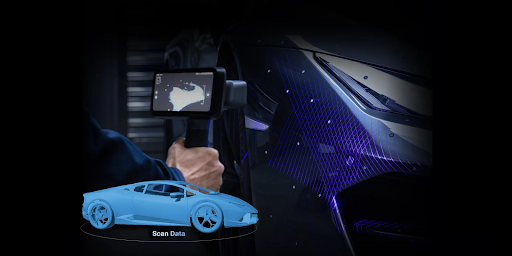
The ability to capture a physical object and turn its shape into usable digital information has changed the way many designers, engineers, and technicians approach their work. Instead of relying entirely on manual measurements, a modern 3d scanner can collect detailed surface information and create a digital representation that can be processed, inspected, redesigned, or used as part of a manufacturing workflow.
One of the newer systems in this category is the Afinia EinScan Rigil Tri-Mode Laser 3D Scanner. Distributed by Afinia 3D and developed by SHINING 3D, the EinScan Rigil combines blue laser scanning, infrared technology, onboard computing, and multiple operating configurations in a handheld system. The manufacturer describes it as a tri-mode scanner designed to provide flexibility across different scanning situations.
Rather than being limited to one particular type of object, the system is intended to support a range of professional and prosumer applications, including automotive work, product development, reverse engineering, and general 3D modeling.
Turning Physical Objects Into Digital Assets
A major advantage of 3D scanning is the ability to preserve the geometry of a physical object digitally. This can be particularly useful when the original design documentation is missing or when an existing component needs to be modified.
For example, an automotive workshop may have a physical trim component that needs to be redesigned. Measuring every curve manually could take considerable effort. With a suitable 3d scanner, the technician can capture the component from multiple angles and create a digital representation.
That information can then become part of a larger workflow. The scan may be cleaned, aligned, measured, edited, or imported into design software depending on the intended application.
This makes scanning useful not only for creating digital copies but also for connecting physical products with modern design processes.
Three Scanning Approaches in One Device
The EinScan Rigil stands out because it combines three scanning approaches. Its system includes crossed blue laser lines for faster capture, parallel blue laser lines for detailed scanning, and an infrared VCSEL mode designed for rapid scanning and wider coverage.
This arrangement gives users the opportunity to change their approach according to the object being captured.
A larger object may benefit from a faster scanning mode that covers more surface area efficiently. A component containing fine geometric details may require a more detailed laser approach. Having these options within the same device can reduce the need to use separate scanners for different projects.
The manufacturer also states that the laser modes can be switched during a scanning project and their captured data can be merged. This can allow an operator to combine speed with additional detail where necessary.
A More Flexible Way to Work
Another interesting aspect of the system is that scanning does not necessarily have to remain tied to a desktop computer.
The EinScan Rigil provides three working configurations: standalone operation, wireless connection to a PC, and wired PC operation. In standalone mode, scanning and processing can be performed directly on the device. Wireless PC mode uses Wi-Fi 6 to connect with a computer, while wired operation provides a conventional cable connection.
This flexibility can be useful in workshops and other environments where moving a large object to a computer workstation is inconvenient.
A technician could capture data near a vehicle, machine, prototype, or other large object and then choose the processing method that best suits the project.
Useful for Automotive Projects
Automotive applications are one of the areas specifically highlighted by the manufacturer. Vehicle components can have complicated curves and irregular surfaces that are difficult to reproduce accurately using basic measuring tools.
A handheld 3d scanner can provide a practical way to capture these surfaces.
For example, a workshop working on custom body modifications could scan part of a vehicle before developing a replacement or modified component. The digital geometry could then be used as a reference during design.
The same concept can apply to interior components, aftermarket parts, custom modifications, and replacement components where obtaining original CAD data may not be practical.
Capturing Challenging Surfaces
Real-world objects are not always easy to scan. Dark or reflective materials can present difficulties for optical scanning technologies, while bright outdoor environments can also affect certain scanning systems.
The EinScan Rigil uses a combination of blue laser and infrared VCSEL technology. SHINING 3D states that the system is designed to provide adaptability across different materials and lighting conditions, including reflective surfaces and outdoor environments.
That does not mean every object will automatically scan perfectly. Surface condition, geometry, positioning, tracking, and operator technique still matter. However, having multiple capture technologies can give the operator more options when a particular surface proves difficult.
Supporting Reverse Engineering
Reverse engineering is another practical area where a professional scanner can become valuable.
Imagine a company has an older mechanical component but no longer has access to the original CAD file. Recreating the part entirely from manual measurements could involve significant effort.
A scan can provide a detailed digital reference of the existing component. Engineers can then identify important dimensions and reconstruct the geometry in their preferred CAD environment.
The scan itself should not automatically be treated as a finished engineering model. Depending on the project, additional modeling, dimensional verification, and quality checks may be required. Nevertheless, the digital capture can provide an important starting point.
From Scanning to Design
The usefulness of a scanner becomes even clearer when it is connected to downstream design software.
After capturing an object, users can process the resulting data and prepare it for applications such as CAD reconstruction, inspection, visualization, or manufacturing.
SHINING 3D’s software ecosystem includes EXModel, which the company describes as a tool for reverse engineering and transforming mesh data into CAD solid models.
This type of workflow allows a physical component to become part of a digital engineering process instead of remaining an isolated scan.
For designers, that can mean using an existing object as a reference when developing a new product. For engineers, it can mean reconstructing legacy components. For manufacturers, it can support inspection and comparison tasks.
Built-In Computing for Greater Portability
Many professional scanning workflows depend heavily on a computer for processing. The EinScan Rigil takes a different approach by incorporating computing hardware directly into the scanner.
According to the official product information, the system includes onboard storage and processing hardware, allowing scanning and processing to take place directly on the device in standalone mode.
The device also includes a touchscreen and replaceable batteries, features that support mobile use.
This can be particularly useful when scanning needs to take place away from a traditional workstation. Instead of treating portability as an accessory feature, the system integrates it into the overall workflow.
Considering Accuracy and Resolution
For professional scanning, specifications such as accuracy and resolution are important, but they should always be considered in relation to the actual application.
SHINING 3D lists volumetric accuracy of up to 0.04 + 0.06 mm/m for the laser mode and geometric resolution of up to 0.05 mm for the EinScan Rigil. The official specifications also list different scanning speeds and working distances for its laser and infrared modes.
These specifications provide a useful reference when evaluating the equipment, but real-world results depend on factors such as object geometry, surface characteristics, scanning technique, alignment, and processing.
For critical measurement applications, appropriate inspection procedures should therefore be used rather than relying solely on headline specifications.
Where a 3D Scanner Fits Into Modern Workflows
A scanner is most useful when it solves a specific problem within a broader workflow.
For a designer, it can provide geometry from a physical prototype. For an automotive professional, it can capture vehicle components. For an engineer, it can provide reference data for reverse engineering. For a manufacturer, it can contribute to inspection and digital documentation.
The Afinia EinScan Rigil Tri-Mode Laser 3D Scanner is designed around this type of flexibility, combining several scanning technologies and operating methods in one handheld platform. Its three work modes and hybrid light approach are intended to let users adapt the equipment to different environments and scanning requirements.
Conclusion
3D scanning is becoming an increasingly practical link between physical objects and digital engineering. A capable 3d scanner can reduce reliance on manual measurements while providing detailed geometry that can be used for design, inspection, reverse engineering, and manufacturing.
The Afinia EinScan Rigil Tri-Mode Laser 3D Scanner takes this concept further by combining multiple scanning technologies with standalone, wireless, and wired operation. Its blue laser and infrared capabilities give users different options for handling objects of varying sizes, surfaces, and levels of detail.
For professionals looking to bring physical components into a digital workflow, the real value of a system like this lies not only in capturing an object’s shape, but in what can be done with that data afterward. When scanning, processing, CAD, inspection, and manufacturing are connected effectively, a physical object can become a useful digital asset for the next stage of a project.
See more amazing information. Visit: Freely Magazine
